

Asus VG249Q Review: The ASUS TUF Gaming VG249Q was one of the most popular budget 1080p gaming monitors. It pairs a 23.8-inch IPS panel with a 144Hz refresh rate, accurate colors and a fully adjustable stand. ASUS has since discontinued it and replaced it with faster TUF models, including the 200Hz VG249Q5A and VG249Q5R. So is it still worth buying if you find one, or should you get a newer model?
This review is research-based. We did not test the monitor ourselves. We pulled together ASUS specs, retailer listings and owner feedback, then compared it with the newer VG249Q models.
Table of Contents
- ASUS VG249Q Monitor Review Summary
- ASUS VG249Q Monitor Technical Specifications
- ASUS VG249Q User Manual
- Detailed ASUS VG249Q Review
- Pros of ASUS VG249Q Monitor
- Cons of ASUS VG249Q Monitor
- Is the ASUS VG249Q Still Worth Buying in 2026?
- Models Similar To ASUS VG249Q
- Frequently Asked Questions about ASUS VG249Q
- Final Thoughts
ASUS VG249Q Monitor Review Summary
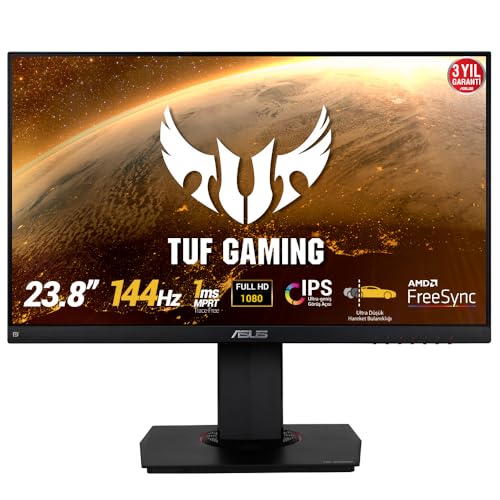
A budget 23.8-inch 1080p IPS monitor with a 144Hz refresh rate, accurate colors and a fully adjustable stand. It still works well for casual and competitive gaming, but it is discontinued. The newer VG249Q5A and VG249Q5R run at 200Hz with faster response times for similar money.
Positives
- Inexpensive
- Accurate and consistent colors
- AMD FreeSync and MBR up to 144Hz
- Wide viewing angles
- Low Input Lag
- Height, tilt, swivel and pivot stand
Negatives
- Discontinued; newer models are faster
- Pixel response time could be faster
ASUS VG249Q Monitor Technical Specifications
| Screen Size | 23.8-inch |
| Panel Type | IPS |
| Resolution | 1920×1080 (Full HD) |
| Aspect Ratio | 16:9 (Widescreen) |
| Refresh Rate | 144Hz |
| Response Time | 4ms (GtG) |
| Response Time (ELMB) | 1ms (MPRT) |
| Adaptive Sync | FreeSync (48Hz-144Hz) |
| Speakers | 2x2W |
| Ports | DisplayPort 1.2, HDMI 1.4, VGA |
| Contrast Ratio | 1000:1 (static) |
| Brightness | 250 cd/m2 |
| Colors | 16.7 million (6-bit + FRC) |
| VESA | Yes (100x100mm) |
| Stand | Height, tilt, swivel and pivot |
| Status (2026) | Discontinued; replaced by the VG249Q3A, VG249Q5A and VG249Q5R |

ASUS VG249Q User Manual
Here is the ASUS VG249Q user manual guide: (PDF).
Suggested Reading:

Best Monitors With Built-in Webcam
Detailed ASUS VG249Q Review
A) Design
The ASUS VG249Q offers a familiar aesthetic that just works and can be found on most of its gaming display variants.
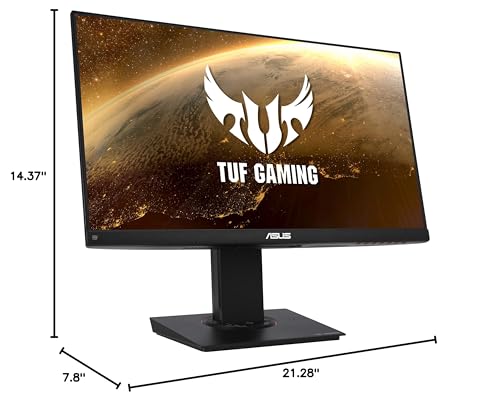
- The monitor has a matte black body that is easy to maintain and protect from smudges, fingerprints, or dust.
- The screen is unframed on three sides, allowing users to enjoy the view with lesser distractions.
- Additionally, the ASUS VG249Q offers a familiar form factor and is not overbearing in terms of weight and size. The 23.8-inch model fits on most desktops and has plenty of room for other peripherals.
- The stand adjusts for height, tilt and swivel, and it pivots into portrait mode. That is rare at this price, and later versions such as the VG249Q1A dropped it for a tilt-only stand.
Build quality is solid for a budget monitor, and owners rarely complain about the stand.
- One drawback is that the on-screen menu uses buttons instead of the joystick found on pricier ASUS models.
- The buttons sit under the bottom edge, so you cannot see them unless you tilt the screen up.
- It is easy to press the wrong button at first, but you get used to it.
Suggested Reading:
Best Monitor Stand For 2 Monitors
B) Image Quality
Based on a 23.8-inch IPS panel from PANDA, the ASUS VG249Q monitor offers a 178-degrees viewing angle, a maximum brightness of 250 nits, 16.7 million colors (6-bit + FRC), and a 1000:1 static contrast ratio.
- These specifications are standard for gaming monitors in this price range. Maximum brightness of 250 nits may seem low on paper, but under normal viewing conditions, the screen is bright enough. In fact, you probably want to reduce the brightness from the maximum setting.
- VA monitors in this price range have a higher contrast ratio, so blacks on the VG249Q are not as deep. IPS has other advantages.
- The benefits include wider viewing angles, more vivid color reproduction, and generally faster pixel response time.
- Also, the monitor has a color gamut of 72 percent NTSC, which corresponds to about 99 percent sRGB. This means the colors are vibrant, consistent, and accurate.
- Finally, the monitor has a flicker-free backlight and a built-in low blue light filter with four (4) different reduction levels, which can help prevent eyestrain and headaches caused by prolonged monitor usage.
Suggested Reading:
Asus VG279Q Review (Updated)
C) Performance
Input lag is the time it takes for a monitor to respond and display your commands. Input lag on the VG249Q is low at 144Hz, so it suits fast competitive games.
- Response time is the time it takes for pixels to change from one color to another. ASUS reports a pixel response time of 4ms (gray to gray transition), but this is not the actual average response time.
- As a result, in fast-paced video games, you may notice slight trailing and motion blur behind fast-paced objects. The amount of visible ghosting is quite tolerable, and there is not as much black spot as on some VA panel monitors. While there are faster IPS monitors available, they are more expensive.
- For most people, the VG249Q is fast enough for competitive gaming. If you are very sensitive to motion blur, the newer 200Hz VG249Q5A and VG249Q5R use faster Fast IPS panels.
- The monitor supports AMD FreeSync over HDMI and DisplayPort with a variable refresh rate (VRR) range of 48 to 144 Hz.
- This technology enables the monitor to synchronize its refresh rate with the frame rates of the GPU, thus eliminating screen stuttering and tearing with marginal input lag.
- Although the VG249Q isn’t certified as G-SYNC compliant by NVIDIA, VRR performs well when used with supported NVIDIA graphics cards (GTX 10 series or later).
- You can also use Extreme Low Motion Blur (ELMB) technology. When enabled, ELMB activates the monitor backlight, reducing perceived ghosting and providing smoother movement clarity.
D) Features
On the lower panel on the right side of the monitor, there are two (2) shortcut buttons, one power button, and four (4) hotkeys you can use to navigate the OSD menu.
- Other valuable features include customizable crosshair overlays, pre-calibrated picture presets, an FPS counter, an on-screen timer, and Shadow Boost, which enhances the visibility of objects in shadow.
- In addition, you’ll also find the standard image adjustment tools such as color temperature, contrast, brightness, as well as sharpness and saturation settings.
- However, no gamma presets are available. For better picture quality, ensure ASCR and VividPixel options are turned off.
- The Trace Free function adjusts the monitor’s pixel response time saturation in 20 increments from 0 to 100.
- Owners commonly suggest a setting of “60“. The “80” and “100” settings add overshoot, which shows up as bright trails (inverse ghosting).
E) Connectivity
Connectivity options on the ASUS VG249Q include DisplayPort 1.2, HDMI 1.4, VGA, and a headphone jack for the two built-in 2W speakers. DisplayPort and HDMI inputs support 144Hz at 1080p and FreeSync. For NVIDIA cards, FreeSync only supports DisplayPort.
Suggested Reading:

Best Video Card For VR
Pros of ASUS VG249Q Monitor
- Uses a generic power cord, no AC adapter required.
- Comes with a DisplayPort cable.
- You can turn off the power indicator during use.
- Excellent image quality
- Calibration out of the box is decent (particularly 2.24 gamma is good).
- Good contrast for IPS (1000: 1 ready to use).
- Owners rarely report backlight bleed.
- Height, tilt, swivel and pivot adjustable stand.
Cons of ASUS VG249Q Monitor
- The pixel response time could be faster.
- Menu buttons instead of a joystick.
- Discontinued, so new stock is limited.
Is the ASUS VG249Q Still Worth Buying in 2026?
Only if you find it at a low price. It is still a good 144Hz IPS monitor, and its adjustable stand beats most budget models. But ASUS has discontinued it, and newer TUF models are faster for similar money.
- Buy it if you find one new or open-box at a clear discount, or you need the full height, swivel and pivot stand.
- Skip it if you want more than 144Hz. The newer models below run at 180Hz to 200Hz.
Newer ASUS TUF Models to Consider
- ASUS TUF Gaming VG249Q5A: 200Hz Fast IPS with a 0.3ms (min.) GtG response time, G-SYNC Compatible and FreeSync Premium certified, and 99% sRGB.
- ASUS TUF Gaming VG249Q5R: also 200Hz Fast IPS with ELMB motion blur reduction and built-in stereo speakers. ASUS rates it at 100% sRGB.
- ASUS TUF Gaming VG249Q3A: a 180Hz Fast IPS model with a 1ms (GtG) response time and 99% sRGB, usually the cheapest of the three.
Check the stand before you buy. Many newer budget TUF models use a simpler stand than the original VG249Q.
Models Similar To ASUS VG249Q
The ASUS VG249Q is similar to the ASUS VP249QGR. The VG249Q adds adjustable motion blur reduction (ELMB), a fully adjustable stand and a wider color gamut. If you want a faster 1080p monitor, look at the BenQ EX2510, which uses a 24.5-inch IPS panel.
Frequently Asked Questions about ASUS VG249Q
Q: Is the VG249Q 1ms?
A: Only with ELMB turned on. ASUS rates the VG249Q at 1ms MPRT, which uses backlight strobing to reduce blur. Its gray-to-gray pixel response is rated at 4ms. If you want true fast GtG response, the newer VG249Q5A and VG249Q5R are rated at 0.3ms (min.).
Q: Can you overclock the ASUS VG249Q?
A: Not officially. The VG249Q is rated for 144Hz. Its successor, the VG249Q1A, overclocks to 165Hz. Owner reports show no frame skipping on the VG249Q at 144Hz.
Q: What is the difference between the VG249Q, VG249Q5A and VG249Q5R?
A: All three are 23.8-inch 1080p IPS monitors from the ASUS TUF Gaming line.
- VG249Q: the original model. 144Hz, fully adjustable stand. Now discontinued.
- VG249Q5A: 200Hz Fast IPS, 0.3ms (min.) response time, G-SYNC Compatible and FreeSync Premium, 99% sRGB.
- VG249Q5R: 200Hz Fast IPS with ELMB and built-in stereo speakers, rated at 100% sRGB.
Q: Is the ASUS VG249Q discontinued?
A: Yes. Several retailers list the VG249Q as discontinued, and its first successor, the 165Hz VG249Q1A, has also been phased out in many markets. The current 24-inch TUF models are the VG249Q3A, VG249Q5A and VG249Q5R.
Final Thoughts
The ASUS VG249Q is a solid budget 1080p IPS monitor. Colors are accurate, input lag is low, and its stand adjusts in every direction, which is rare at this price.
Its weak points are a modest 144Hz refresh rate, average pixel response and menu buttons instead of a joystick. It is also discontinued. Buy it only at a clear discount. Otherwise, the 200Hz VG249Q5A or VG249Q5R is the better buy.
Check Price at Amazon